It was interesting to watch the Credit Suisse Fear Barometer rise from the low 20′s in December to an all time high of almost 32 in late February. If you do not remember, the CS Fear Barometer measures “fear” built into implied volatility skew by looking at zero cost collars on the S&P 500. The index assumes that you sell a 3-month, 10% out of the money call and use the proceeds to purchase a 3-month out of the money put. The moneyness of the put option that you can afford is the index itself, so if the index is at 25 it implies that you can purchase a 3-month put 25% out of the money with the premium that you received from selling the 10% OTM 3 month call.
Since index inception in November of 1994, this average level has been 16.9%. With the market turbulence of the last five years, the average has been closer to 20%:
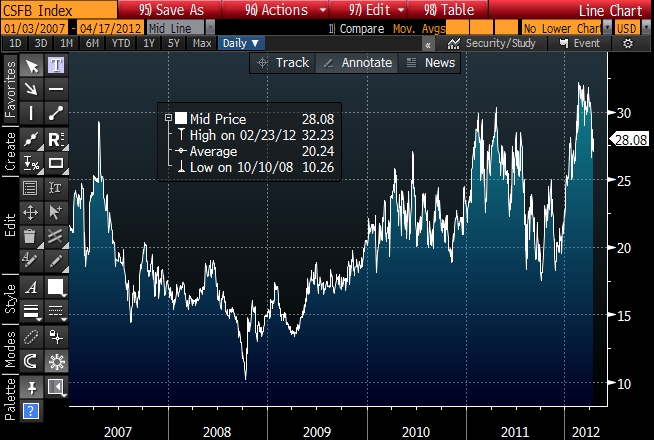
I talked about this index in April 2011 and I am mentioning it again in April 2012. “It certainly does not give me a comfortable backdrop for being overly bullish.”

Related posts:


I was curious if you could expand on your comments about this index. I find it confusing because typically people think of investor “fear” peaking as the market bottoms. Usually it is “greed” that is peaking at the same time as the market. Yet this so called fear index usually peaks with the market and bottoms with the market. Fall of 2008, spring of 2009, 2011, etc. all look lined up with the market — maybe not the exact dates but close enough especially on the longer time horizon of your chart.
My theory is that the use of out of the money puts drives put IV higher than call IV until the VIX rises and the call IV catches up.
Do you have any thoughts on why the index behaves the way it does?
thanks
The CS Fear Barometer is a measure of a 3-month S&P 500 zero cost collar. If I sell my upside at 10% above the current market, how much of an out of the money put can I afford? If this index is high, it generally means that there is less demand for long call positions than long put positions OR that there is less supply of put sellers and more supply of call sellers. Basically the supply/demand equation is imbalanced in which puts are more highly valued than calls. This is nearly always the case because the market does not generally “crash” up as it crashes down (a way of saying returns are not normally distributed), but the extent of this mismatch is shown in the index, therefore you would expect this index to spike when the market is “overbought” and decline when the market is “oversold”.
Thanks for your comments. My trouble with this index is that most measures of market sentiment are interpreted from a contrarian perspective but this one is not. The fact that typically put volumes and put IV spike as the market declines makes it easy for me to assume that skew as measured by this index would spike near market lows.
The fact that this index has a pattern opposite of that — peaking at market peaks suggests that skew is driven more by “smart” money. No idea if this is technically correct but the analogy that comes to mind is specialist short interest (either ratio or just the level) that people would monitor when we actually had specialists on the NYSE. While overall short interest would peak at market bottoms, specialist short interest would peak at market tops. Seems like dumb money drives IV or the VIX higher, while smart money drives changes in skew.
To summarize your last line about assuming the fear index would rise when the market was overbought and fall when it is oversold is not as intuitive for me to understand as it is for you.
i
What happened to this indicator? I used to be able to find it on Bloomberg but now it is gone.