Skip to content


Market Volatility and Returns


Do returns dictate volatility or does volatility dictate returns?  It might seem like a silly question, but one that is worth spending a bit of time on.  If market returns actually followed normal distributions, then we might expect that there are as many up days as down days and upside deviation equals downside deviation.  Unfortunately, the distribution of returns is rather non-normal with a larger number of negative returns and a lot of small positive returns.  You can read about option pricing and equity return distributions at a popular old post, “Do Black Swans Negate Option Premiums“.

The question for today is whether volatility necessarily means that returns are negative.  For this little bit of analysis, we will look at the S&P 500 daily returns going back to 1928.  The data is calculated into calendar month statistic sets and then the sets are grouped by realized volatility buckets:
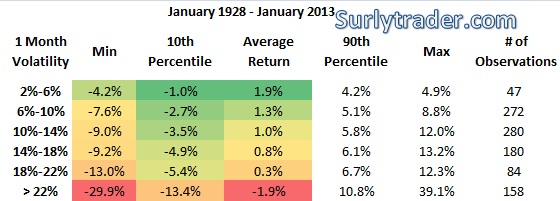
Monthly returns for low volatility months are higher than high volatility months

The data is pretty consistent across all metrics.  Low realized volatility generally corresponds to higher average returns whereas high realized volatility generally corresponds to lower average returns.  We can also see that (as expected and almost by definition) the dispersion between the highest and lowest returns increases as the volatility increases.

The question that arises is whether this has practical implications.  It has almost become an industry accepted fact that no one can predict the equity market.  Has it also become a fact that no one can predict future market volatility?  A quick google search would show you that there is quite a lot of literature that suggests volatility is much easier to predict.

Share and Enjoy:
  • Print
  • Digg
  • del.icio.us
  • Facebook
  • Google Bookmarks
  • Blogplay
  • Reddit

Related posts:

  1. Volatility of Volatility
  2. Stagnant Volatility and Investment Choices
  3. Long-Dated Volatility Opportunities
  4. What is “Normal” Volatility?
  5. Understanding the S&P 500 VEQTOR Index

Posted in Markets, Trading Ideas.

Tagged with , , , , , , , , .


One Response

Stay in touch with the conversation, subscribe to the RSS feed for comments on this post.

Continuing the Discussion

  1. Wednesday links: social connections - Abnormal Returns | Abnormal Returns linked to this post on February 13, 2013

    [...] On the relationship between market volatility and returns.  (SurlyTrader) [...]


Some HTML is OK

or, reply to this post via trackback.


Get Adobe Flash playerPlugin by wpburn.com wordpress themes
DISCLAIMER - The content of this site is for informational and entertainment purposes only and is not to be viewed as trade recommendations or financial advice from the author. The author is not a registered investment adviser. There is no substitute for your own due diligence. Please be aware that investing is inherently a risky business and if you chose to follow any of the advice on this site, then you are accepting the risks associated with that investment. SurlyTrader and its agents assume no responsibility for any consequence relating directly or indirectly to any action or inaction you take based on the information, services or other material on this site. While SurlyTrader strives to keep the information on this site accurate, complete, and up-to-date, SurlyTrader and its suppliers cannot guarantee, and will not be responsible for any damage or loss related to, the accuracy, completeness or timeliness of the information The Author may have also taken positions in the stocks that are being discussed and the author may change his position at any time without warning.

Copyright © 2009-2013 SurlyTrader

Yellow Pages for USA and Canada SurlyTrader - Blogged ypblogs.com