It is funny how some of the most important market events get little attention. Since the beginning of November when interest rates started to move, the 30 year mortgage rate has skyrocketed about 1%. This is not an insignificant market event at all:
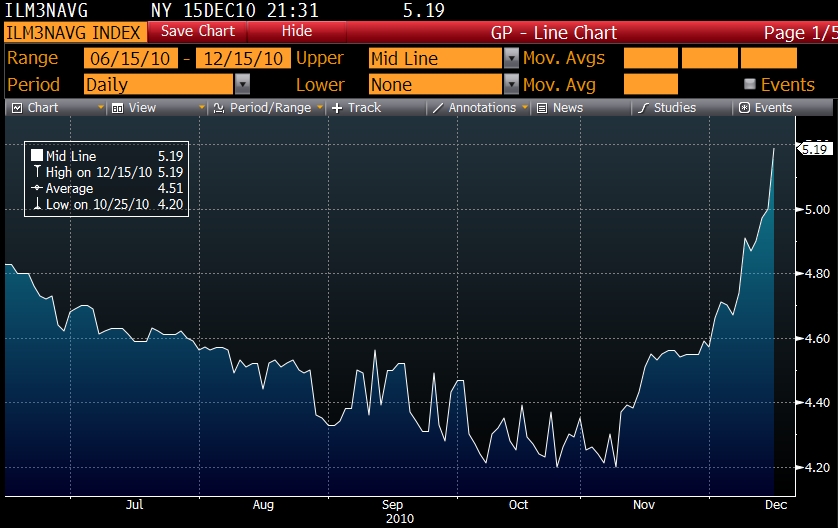
There goes affordability...or housing prices
One of the biggest reasons that Bernanke been aggressive with quantitative easing is to target lower long term interest rates and specifically lower mortgage rates. Lower mortgage rates make homes more affordable and keep housing prices from dropping further. If we look at mortgage rates and loan amounts, we can see that monthly payments move aggressively with the level of interest rates:

All else equal, a 6% mortgage on $200k is the same as a 4% mortgage on $250k
This tells us that a $250,000 mortgage at 4% is similar in monthly payment to a $200,000 mortgage at 6%. This implies that at that loan level, every 1% in interest rates corresponds to $25,000 in buying power. All else being equal, a move from 4% to 6% on mortgage rates would reduce a $250,000 house in value to $200,000. This ignores taxes, down-payment, demand, and supply but it definitely puts the importance into perspective.
I just wonder how long it will take for these higher mortgage rates to feed back into the housing market demand/supply equation./